
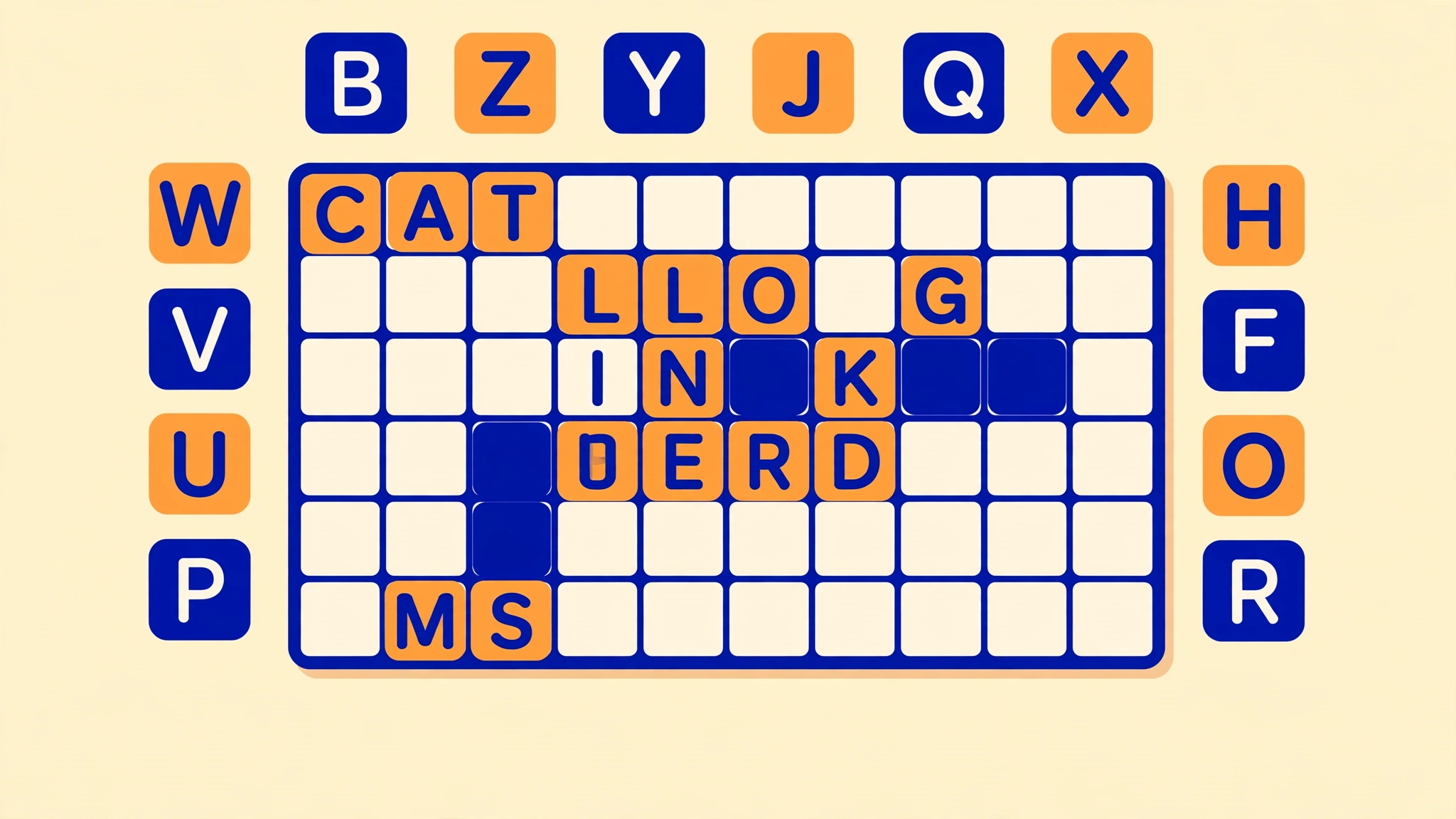
Unolingo is a crossword-without-clues puzzle played on a 10×10 crossword-style grid. Twenty-six squares are empty, and you must place each letter of the alphabet exactly once so that every row and column forms real English words. Pronounced "you-know-lingo," it works like Sudoku but with letters: the same deductive logic, none of the trivia. It is played daily on USA Today's puzzles site, where it sits alongside the crossword, KenKen, and other staples.
How Unolingo Works
Every Unolingo puzzle starts as a standard-looking crossword grid: 10 rows by 10 columns, black squares, white squares, and crossing entries. The twist is that every square already contains a letter except 26 of them — and those 26 empty squares correspond to the 26 letters of the alphabet.
The rules are simple:
- Each letter A through Z goes into the grid exactly once. You must place every letter of the alphabet, and you may not repeat one.
- Every across and down entry must be a real English word. When the grid is complete, all rows and columns read as valid words.
- There are no clues. You solve purely by deduction, word knowledge, and pattern recognition.
Because each letter appears only once, Unolingo is self-verifying in the same way Sudoku is: if you have used the letter E in one square, it cannot go anywhere else. That single rule drives most of the solving strategy.
The Origin: Equazi Enterprises and the App
Unolingo was created by Equazi Enterprises LLC and launched on iOS in December 2011 under the name Unolingo: Crosswords Without Clues (sockscap64.com; game-solver.com). The app offered 20 introductory puzzles plus hundreds more, four difficulty levels, hint and audit functions, and puzzles that take a typical solver between five and fifteen minutes.
The app's success came from its elegant premise: "What a Sudoku puzzle does using numbers, Unolingo does using each letter of the alphabet." Within a few years of release, it had climbed the app charts and, per the print edition's publisher copy, amassed over half a million downloads, played in every US state and more than 100 countries (buscalibre.es). In 2014, Andrews McMeel Publishing released Unolingo: 100 Crosswords Without Clues in print, including a Pocket Posh edition by The Puzzle Society, putting the puzzle on bookshelves next to Sudoku and crossword collections (thriftbooks.com).
Today, Unolingo's most prominent home is Puzzles USA Today (puzzles.usatoday.com), where it appears as a syndicated Uclick game — the same syndication family that supplies USA Today's crosswords and other daily puzzles (tecdud.com). That placement means millions of newspaper readers encounter it as a daily puzzle alongside their morning crossword.
How to Play Unolingo on USA Today
- Open the USA Today puzzles page and choose Unolingo (games.usatoday.com or puzzles.usatoday.com).
- Look at the grid: a 10×10 crossword with 26 blank squares.
- Start with the entries you can complete. Short words with unusual letter combinations are the best footholds.
- Every time you place a letter, strike it off your alphabet — it cannot be used again.
- Use crossing entries to test hypotheses: if placing a T completes two words at once, it is probably right.
- Work toward the corners and edges, where entries are shortest and most constrained.
The USA Today version plays in the browser, free, with new puzzles appearing regularly. It is one of several Uclick-syndicated word games on the site, and it has a loyal following among solvers who find traditional crosswords either too trivia-heavy or too easy.
Unolingo vs Sudoku vs Crosswords
| Feature | Unolingo | Sudoku | Crossword |
|---|---|---|---|
| Grid | 10×10, crossword-style | 9×9, uniform | 15×15 or varied |
| What you place | 26 letters, once each | Digits 1–9, no repeats per row/column/box | Letters from clues |
| Clues | None | None (numbers given) | Yes, trivia + wordplay |
| Core skill | Vocabulary + deduction | Pure logic | General knowledge |
| Time to solve | 5–15 minutes | 5–30 minutes | 10–30+ minutes |
| Knowledge required | English words | None | Broad trivia |
Unolingo sits exactly between Sudoku and the crossword: it demands real word knowledge like a crossword, but the solving method is pure logic like Sudoku. If you can solve a Sudoku and you know the English language well, you can solve a Unolingo. Curious how deduction puzzles compare? See what Plusword is for another daily logic-word hybrid.
Strategies for Solving Unolingo
This deductive-reasoning word puzzle rewards methodical play over speed. Core techniques:
Start with the rarest letters
Q, X, Z, J, and K have very few places they can plausibly fit in a crossword grid. A three-letter entry ending in Q is almost certainly not happening — use this constraint aggressively. Similarly, words containing X or Z are rare enough that once you spot a candidate crossing pattern, you can lock in the letter.
Use short entries first
Two- and three-letter entries have the fewest possible words. If a two-letter across entry crosses a five-letter down entry, the two-letter slot constrains the long entry's middle letter enormously. Solve the small ones, then let them unlock the long ones.
Track your alphabet
The no-repeat rule is your best friend. Keep a list of unused letters. When only one consonant is missing and an entry needs a consonant, you have found it by elimination. The hint and audit functions in the app versions do some of this work for you, but doing it mentally is faster once practiced.
Think in word endings
English crosswords love the endings -ING, -ED, -ER, -EST, and -LY. If a vertical entry's last three letters read _NG, an I and G are strong candidates. Familiarity with common prefixes (UN-, RE-, DE-, PRE-) and suffixes works the same way in reverse.
Work from the black squares inward
Black squares split the grid into entries. Long entries that cross many shorter ones are the keystones of a puzzle — solving even one or two letters of a nine-letter entry can cascade through the whole grid.
Common English word shapes
The puzzles are hand-crafted from common English words — the publisher describes the vocabulary as words "more likely to be heard at a party with friends than in the classroom" (game-solver.com). Do not reach for obscure Scrabble words; the answer is almost always a familiar one.
Why Puzzlers Love Unolingo
Unolingo appeals to two audiences that rarely overlap: Sudoku solvers who want words, and crossword solvers who want logic. It removes the biggest barrier of the daily crossword (obscure trivia) while keeping the satisfaction of completing real English words. The 5-to-15-minute solve time makes it a perfect daily ritual — longer than Wordle, shorter than a full crossword, and infinitely replayable because the deduction is different every time.
Its appearance on USA Today gives it something few indie puzzles achieve: a daily audience of mainstream solvers. For many players, Unolingo is simply "that crossword with no clues" in their morning routine, discovered by accident and kept out of loyalty. If you prefer your daily puzzle with clues instead, our how to play Plusword guide covers a crossword-style word search game.
Where to Play Unolingo Free
- USA Today Puzzles — the daily browser version on USA Today's games hub (puzzles.usatoday.com), free to play.
- Unolingo app (iOS) — Unolingo: Crosswords Without Clues by Equazi Enterprises LLC, originally free with in-app puzzle packs.
- Print — Unolingo: 100 Crosswords Without Clues (Andrews McMeel Publishing, 2014) and the Pocket Posh edition for offline solving.
The browser and app versions play identically — the same 10×10 grid, the same 26-empty-square rule — so pick whichever platform is handiest. The print puzzle book is the best option for travel, since this crossword-without-clues format needs no signal once the book is in your hands.
What is Unolingo?
Unolingo is a word puzzle on a 10×10 crossword grid with no clues. You must place each letter of the alphabet exactly once so that every row and column forms a real English word.
Who makes Unolingo?
Unolingo was created by Equazi Enterprises LLC, which launched it as an iOS app in December 2011. It is now syndicated by Uclick and appears daily on USA Today’s puzzles site.
How do you pronounce Unolingo?
It is pronounced “you-know-lingo,” a play on the word lingo.
Is Unolingo free to play?
Yes. The daily browser version on USA Today’s puzzles site is free, and the app launched as a free download with additional puzzle packs available.
How long does a Unolingo puzzle take?
Typically 5 to 15 minutes, depending on difficulty level — shorter than a full crossword, similar to a medium Sudoku.
Is Unolingo like Sudoku?
In structure, yes: both are logic puzzles with a no-repeat rule and no external knowledge required. But Unolingo uses all 26 letters and requires the completed entries to be real English words, so vocabulary matters.
Are there Unolingo books?
Yes. Andrews McMeel Publishing released *Unolingo: 100 Crosswords Without Clues* in 2014, including a Pocket Posh edition, for offline solving.
What is the best strategy for beginners?
Start with the shortest entries and the rarest letters (Q, Z, X, J, K), keep strict track of which letters you have already used, and think in common word endings like -ING and -ED. Sources: sockscap64.com; game-solver.com; thriftbooks.com; buscalibre.es; tecdud.com; fire.kindlenationdaily.com.