
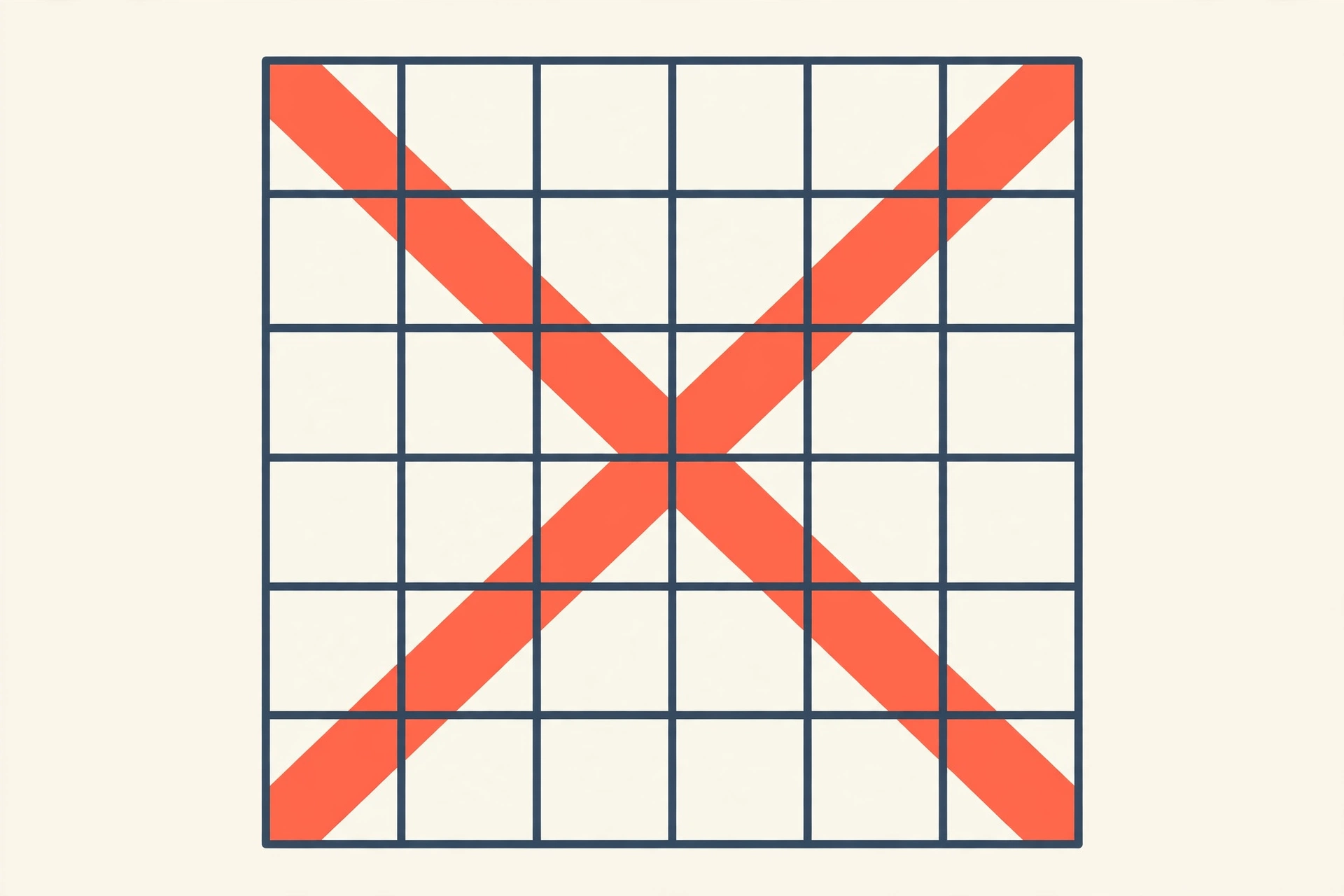
Sudoku X, also called diagonal sudoku, is a logic-puzzle variant of classic sudoku with one extra rule: in addition to every row, column and 3×3 box containing the digits 1–9, both main diagonals of the grid must also contain the digits 1–9 exactly once. That single twist turns a familiar number-placement puzzle into a noticeably tougher logic challenge.
The Rules of Sudoku X
Everything from classic sudoku carries over, plus the X-constraint:
- Standard placement. Every row must contain the digits 1–9 without repetition.
- Standard columns. Every column must contain the digits 1–9 without repetition.
- Regional integrity. Each of the nine 3×3 boxes must contain the digits 1–9 exactly once.
- The X-constraint. The two main diagonals — corner to corner, forming an X across the grid — must each contain a complete set of digits 1–9 with no repeats.
That is the entire ruleset. The diagonals behave like two extra "regions" overlaid on the standard grid, and every valid Sudoku X solution must satisfy all eleven constraints simultaneously (nine boxes plus two diagonals, with rows and columns as usual) — a natural extension of the classic Sudoku ruleset.
Note that only the two long corner-to-corner diagonals count. Shorter diagonals elsewhere on the grid have no special status.
Sudoku X vs Classic Sudoku: What's Different?
| Feature | Classic Sudoku | Sudoku X |
|---|---|---|
| Grid | 9×9 | 9×9 |
| Row/column/box rules | Yes | Yes |
| Diagonal rule | No | Both main diagonals must hold 1–9 |
| Total constraints | 27 (9 rows + 9 cols + 9 boxes) | 29 (adds 2 diagonals) |
| Typical difficulty | Varies by givens | Harder at the same given-count |
| Centre cell | Normal cell | Belongs to row, column, box AND both diagonals — the most constrained cell on the board |
The practical effect: puzzles need fewer givens to have a unique solution, and the diagonals give you powerful extra footholds. A cell on a diagonal is influenced by four constraints at once (row, column, box, diagonal) instead of three, so diagonal cells resolve faster — but they also restrict everything around them more aggressively.
Strategies for Solving Sudoku X
1. Scan the diagonals first
Treat the two diagonals as regions and check them early, exactly as you would check a row or box. Count which digits each diagonal is missing, then look for the only cell on that diagonal where a missing digit can go. Because diagonals cut across nine different boxes, a single diagonal scan often reveals placements that row/column scanning misses (source: gridpuzzle.com diagonal sudoku guide).
2. Exploit the centre cell
The middle cell of the grid (row 5, column 5) sits on both diagonals as well as its row, column and box. It is the single most constrained cell on the board. If you can pin down the centre early, it radiates information in four directions.
3. Work the intersections
Where a diagonal crosses a row, column or box boundary, you get a highly restricted intersection cell. Ask: "this digit must go somewhere on this diagonal — which cells on the diagonal are inside boxes that already contain it?" Intersections are where hard Sudoku X puzzles break open.
4. Cross-reference missing digits
If a diagonal is missing the digit 7, check the rows and columns intersecting the diagonal's empty cells. Often a row already contains 7 elsewhere, eliminating that intersection and leaving only one or two candidate cells on the diagonal.
5. Use pencil marks on diagonals
For trickier puzzles, mark candidates specifically along the diagonals. Because diagonal cells interact with four constraint types, candidate elimination runs faster there than anywhere else on the grid — a pair of candidates on a diagonal cell can unlock a whole region.
Common Mistakes in Sudoku X
- Forgetting the diagonals exist. The number-one beginner error: solving it as a classic sudoku and only noticing the diagonal rule at the end. Check the X-constraint from the first minute.
- Assuming fewer givens means easier. Sudoku X puzzles often ship with fewer starting numbers because the diagonals add solving power. Do not let a sparse grid intimidate you — the diagonals compensate.
- Overlooking the centre. New players treat the middle cell as ordinary. It is the hardest-working cell on the board; prioritise it.
- Guessing instead of scanning. Trial and error is never needed. If you are stuck, re-scan both diagonals slowly — there is almost always a hidden single hiding on the X.
Sudoku X Sizes: 4×4, 6×6 and 9×9
The X-constraint scales to smaller grids, which are excellent training tools:
- 4×4 Sudoku X — each row, column, 2×2 box and both diagonals must contain 1–4. Perfect for learning the diagonal mindset in under five minutes.
- 6×6 Sudoku X — rows, columns, 2×3 regions and diagonals hold 1–6. A genuine step up; the centre four cells (where the diagonals pass through the middle boxes) become the key battleground.
- 9×9 Sudoku X — the full classic experience with the diagonal twist. This is what most people mean by "Sudoku X."
Start with 4×4 to internalise how diagonals behave, then move up. Your diagonal-scanning habit will transfer directly.
Where to Play Sudoku X Free
Several reputable sites offer free diagonal sudoku with daily puzzles and difficulty levels:
- GridPuzzle.com — free diagonal sudoku in 4×4, 6×6 and 9×9 with leaderboards and strategy guides.
- Arkadium — offers a Daily Diagonal Sudoku alongside its classic sudoku (see our Arkadium Sudoku guide).
- Sudoku-specific apps — many sudoku apps include an "X" or "diagonal" mode in their variant packs; check the variant menu before assuming your app lacks it.
The Centre Cell: Your Most Powerful Foothold
In classic sudoku every cell belongs to three constraints — row, column, box. In Sudoku X, the centre cell belongs to five: its row, its column, its box, and both diagonals. That makes it the most information-dense cell on the board, and smart solvers exploit it relentlessly.
Solve the centre first. Because five constraints converge on one cell, the centre resolves earlier than any other cell in the grid. In many Sudoku X puzzles the centre is determinable within the first few minutes — and once placed, it feeds information into both diagonals simultaneously, accelerating everything downstream.
Read the diagonals as units. Most solvers scan rows, columns, and boxes by habit, then remember the diagonals as an afterthought. Reverse the priority: scan each diagonal as a unit looking for hidden singles, exactly as you would a row. A digit missing from a diagonal with only one possible home is a free placement that row-scanning would take much longer to find.
Watch the diagonal intersections with boxes. Each diagonal crosses every 3×3 box exactly once (except the centre box, which it crosses three times). Where a diagonal enters a box, it constrains that box's remaining cells powerfully — a diagonal digit eliminates candidates in its box just as a row digit does. Train yourself to see these crossings as you would row-box intersections.
Beware the "almost X" trap. Only the two long corner-to-corner diagonals count. Shorter diagonals have no special status, and treating them as constrained is a surprisingly common error that produces confident, wrong solutions. When in doubt, trace the diagonal corner to corner — if it does not touch two opposite corners, ignore it.
Final Thoughts
Sudoku X proves how much mileage one extra rule can add: the diagonals rewire your solving instincts and make the centre of the board the star of the show. If classic sudoku has started feeling automatic, the X is the perfect next step.
Keep sharpening your skills with our Arkadium Sudoku guide and the hardest classic difficulty in What Is Evil Sudoku.
What is Sudoku X?
Sudoku X, also known as diagonal sudoku, is a sudoku variant where both main diagonals of the 9×9 grid must each contain the digits 1–9 exactly once, in addition to the standard row, column and 3×3 box rules.
Why is it called Sudoku X?
Because the two constrained diagonals form the shape of the letter X across the grid, corner to corner.
Is Sudoku X harder than regular sudoku?
At the same number of given clues, yes — the extra constraints make each placement carry more consequences. However, the diagonals also give you more solving footholds, so well-designed Sudoku X puzzles feel challenging rather than unfair.
What is the most important cell in Sudoku X?
The centre cell. It belongs to a row, a column, a 3×3 box and both diagonals simultaneously, making it the most constrained — and most informative — cell on the board.
Can Sudoku X be solved without guessing?
Yes. Like classic sudoku, every properly constructed Sudoku X has a unique solution reachable by pure logic — diagonal scanning, intersection analysis and candidate elimination are sufficient.
Does Sudoku X come in other sizes?
Yes. Common versions include 4×4 (digits 1–4, 2×2 boxes) and 6×6 (digits 1–6, 2×3 regions), both with the diagonal rule applied. They are great practice for the full 9×9.
Where can I play Sudoku X online free?
GridPuzzle.com offers free diagonal sudoku in multiple sizes, and Arkadium runs a Daily Diagonal Sudoku. Many sudoku apps also include a diagonal/X mode.
Why is Sudoku X called “X”?
Because the two constrained diagonals form an X shape across the grid, corner to corner. The name distinguishes it from classic sudoku the way “Sudoku X” distinguishes the variant in puzzle books and apps.
Does the centre cell really belong to both diagonals?
Yes — the centre cell sits at the crossing point of the two main diagonals, so it must satisfy its row, its column, its 3×3 box, *and* both diagonals. It is the only cell on the board constrained five ways, which is why it usually resolves first.