
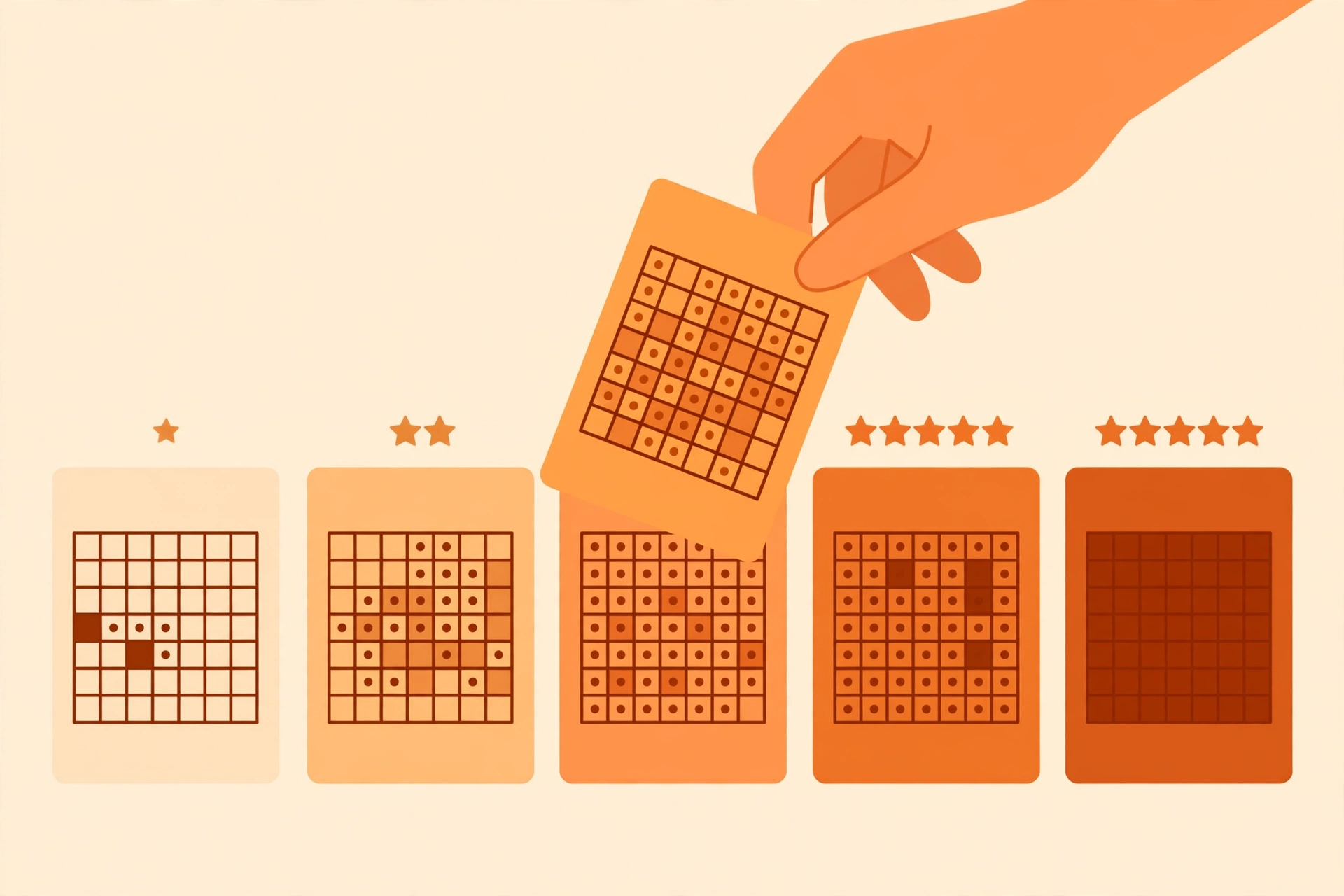
"Select sudoku" simply means choosing a sudoku puzzle to play — picking the right logic puzzle for the moment — and the puzzle you select makes all the difference. Pick one too hard and you will stall in frustration; too easy and you will finish in minutes without any satisfaction. The right choice is a puzzle that matches your current skill level, with a difficulty rating you trust and a source that guarantees a unique solution.
Why Selecting the Right Puzzle Matters
Sudoku puzzles are not all equal. Two grids can look similar yet differ enormously in difficulty, because difficulty comes from the solving techniques required, not just the number of clues. Selecting a puzzle at the right level means:
- You stay in the sweet spot — challenged but not stuck, which is where the fun lives.
- You build skills progressively — each level teaches new techniques.
- You avoid bad puzzles — poorly made grids can have multiple solutions or require pure guessing.
Understanding Difficulty Levels
Almost every sudoku source — apps, newspapers, books — rates these number puzzles on a scale. The names vary, but the standard ladder looks like this:
| Level | Typical clue count | Techniques needed | Who it suits |
|---|---|---|---|
| Easy | 35+ clues | Scanning, naked singles | Complete beginners |
| Medium | 28–34 clues | Hidden singles, pairs | Casual regulars |
| Hard | 20–27 clues | Pointing pairs, triples | Experienced solvers |
| Expert / Evil | Under 20 clues | X-Wing, Swordfish, chains | Advanced players |
Note that clue count is only a rough guide — a well-constructed hard puzzle can have more clues than a sloppy medium one. The techniques required are the truer measure. (Our sudoku tactics guide explains each of these techniques.)
How to Select a Puzzle: Step by Step
1. Be honest about your level
If you have never solved one, start at Easy. If you can finish mediums comfortably in under 15 minutes, try Hard. Jumping two levels at once is the most common cause of abandoned puzzles.
2. Check the difficulty rating
Reputable sources label every puzzle. Avoid collections that do not rate their grids — you have no way to know what you are getting into.
3. Look for a unique solution guarantee
A proper sudoku has exactly one solution — Wikipedia's Sudoku overview describes the single-solution requirement as the defining property of a well-formed puzzle. Quality publishers (established newspapers, well-known apps, curated books) test their puzzles; random internet grids sometimes do not.
4. Prefer symmetrical, well-formed grids
Professionally set puzzles usually have symmetrical clue patterns. It is not a guarantee of quality, but it is a good sign the puzzle was constructed with care rather than generated carelessly.
5. Match the format to the moment
- Five spare minutes? An easy app puzzle.
- A train journey? A medium from the newspaper.
- A quiet evening? A hard or expert from a puzzle book.
Where to Select Sudoku Puzzles
- Newspapers — The Times, Telegraph, Guardian and Metro all run daily sudokus at graded difficulties. Ideal for a daily habit.
- Apps — Most sudoku apps let you select difficulty before each game, with hints and mistake tracking.
- Puzzle books — Bookshops carry volumes organised by level; great value with hundreds of puzzles each.
- Websites — Free daily puzzles at multiple levels, often with printable options.
How Different Sources Rate Difficulty
Difficulty labels are not standardised, which trips up many players. A "hard" in one app can feel like a "medium" in a newspaper. Here is how to calibrate:
- Newspapers (Times, Telegraph, Guardian) tend to grade conservatively — their "hard" is genuinely challenging and their easy puzzles are very gentle.
- Apps often inflate difficulty to keep you playing — try two or three puzzles at a level before deciding where you belong.
- Puzzle books usually print the grading system in the introduction; books aimed at enthusiasts grade tougher than mass-market collections.
- Websites vary wildly — stick to established sudoku sites with user ratings or solver-verified gradings.
The practical approach: solve three puzzles at a new source's "medium". If all three fall in under 15 minutes, that source grades easy and you can move up.
Selecting by Your Goal
Not every session has the same purpose. Select accordingly:
- Learning — pick easy puzzles and focus on applying one new tactic per puzzle.
- Relaxation — choose a comfortable medium you can solve without strain; the flow state is the goal.
- Speed — time yourself on easy/medium grids to build pattern-recognition reflexes.
- Challenge — take on a hard or expert when you have uninterrupted time and patience to spare.
Mistakes to Avoid When Selecting
- Starting at "evil" to prove yourself — you will just practise being stuck.
- Ignoring the rating system — each publisher grades differently; a "hard" in one app may be a "medium" elsewhere. Calibrate with a couple of test puzzles.
- Playing generated puzzles with no solution check — if a puzzle seems to need guessing, it may be broken, not hard.
- Always playing the same level — progress comes from gradually increasing difficulty.
The Bottom Line
Selecting the right sudoku is a skill in itself: match the difficulty to your level, trust rated sources, and step up gradually. Get the selection right and every puzzle becomes the satisfying challenge it should be. Next, learn the tactics that will carry you up the difficulty ladder — and make sure you are saying the name right with our pronunciation guide.
How to Re-Evaluate Your Level Over Time
Your ideal difficulty today will not be your ideal difficulty in three months, so reassessing regularly keeps you in the productive sweet spot.
- Track your solve times. When easy puzzles consistently take under five minutes and mediums fall in under fifteen, you are ready to sample hard grids. If a new level regularly takes more than twice your usual time, drop back down — frustration teaches nothing.
- Review your technique list. Can you spot a hidden single without prompting? Do pointing pairs feel automatic? Each technique that becomes second nature is a signal that the next level's new techniques are within reach.
- Keep a "stuck" log. Note which puzzles you abandoned and why. Patterns — always stalling on the same technique — tell you exactly what to practise rather than guessing.
- Re-test with the same source. Difficulty ratings differ between publishers, so measure progress against one familiar source: the newspaper you read daily or the app you play most.
Most regular solvers move up one level every two to three months of daily play. There is no prize for rushing; players who consolidate each level thoroughly end up stronger at the top than those who skip ahead and stall.
What does “select sudoku” mean?
It means choosing a sudoku puzzle to play — picking the difficulty level, format and source that suit you. It is not the name of a specific product.
How do I know which difficulty to select?
Start one level below what you think you can handle. If you finish easily puzzles in under 10 minutes, move up. If a level takes more than 30 frustrating minutes, move down.
How many clues should a good sudoku have?
Easy puzzles typically have 35 or more clues, medium 28–34, hard 20–27, and expert fewer than 20. But technique requirements matter more than raw clue count.
Where is the best place to select daily sudoku puzzles?
Newspaper puzzle pages (Times, Telegraph, Guardian), dedicated sudoku apps, and free sudoku websites all offer graded daily puzzles. Pick whichever fits your routine.
Should beginners select easy or medium sudoku?
Easy, always. Learn scanning and naked singles on gentle grids first; the techniques transfer directly when you move up.
Can a sudoku puzzle have more than one solution?
A properly constructed sudoku has exactly one solution. If you find two valid completions, the puzzle is flawed — select puzzles from reputable sources to avoid this.
How do I select sudoku puzzles for kids?
Choose 4×4 or 6×6 mini-sudokus, or easy 9×9 grids with 40+ clues, and look for colourful children’s editions rather than dense newspaper grids.
How often should I move up a difficulty level?
Most daily solvers are ready for the next level after two to three months of consistent play. The clearest signal is solve time: when mediums fall in under fifteen minutes comfortably, hard puzzles are worth trying.
Can I mix difficulty levels in one sitting?
Yes, and it is good practice. Warm up with an easy grid, attempt one at your target level, then finish with something comfortable. The variety builds stamina without the fatigue of grinding hard puzzles back to back.