
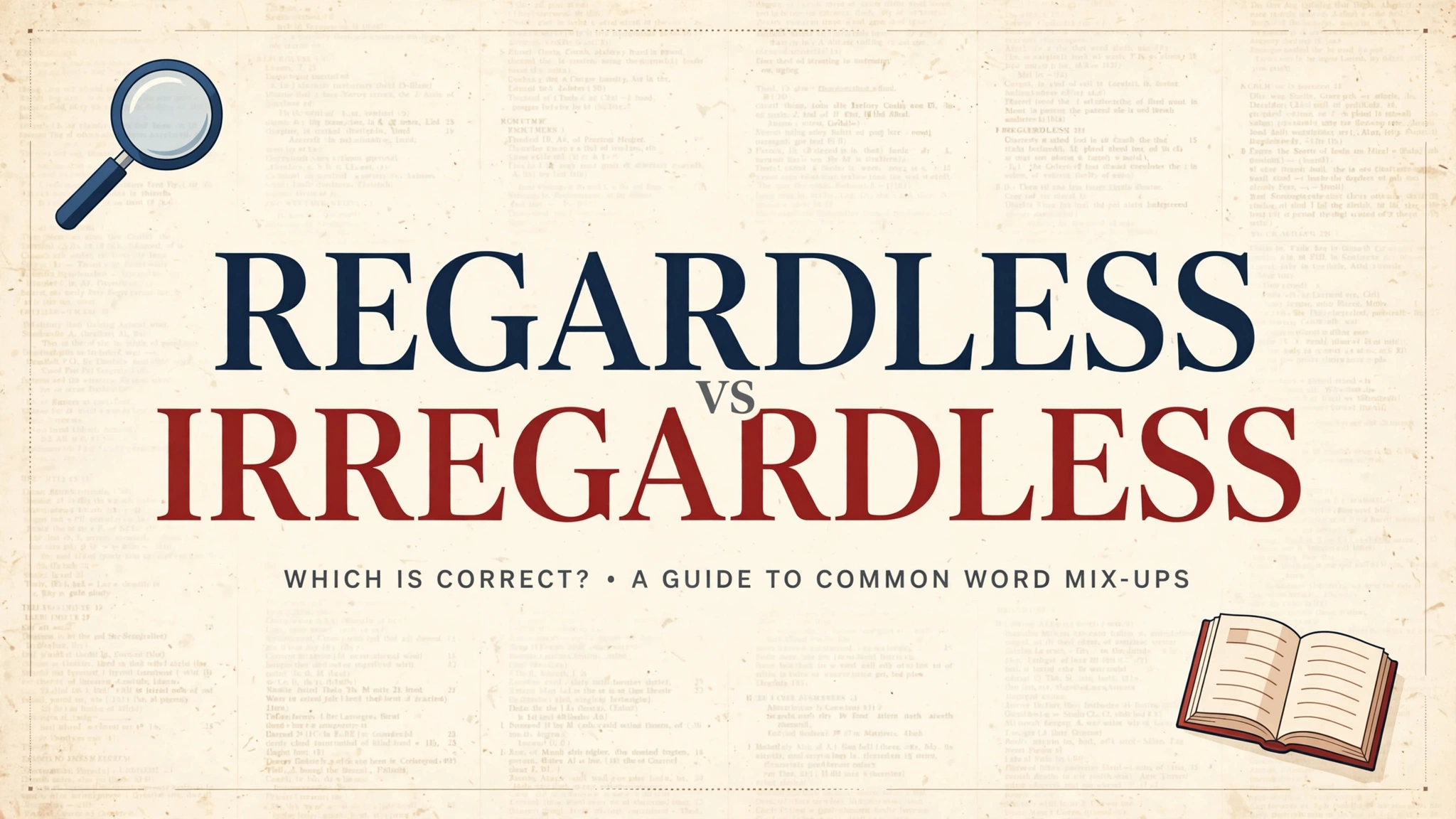
She sent the email, hit send, and only then noticed it: “irregardless of the delay, we will ship today.” Her manager replied within minutes — not about the shipment, but about the word. Small mix-ups like this happen every single day, and in professional life they quietly cost you credibility.
English is full of words that sound right but are not, and phrases everyone misspells simply because of how they are pronounced. In this guide, we settle three of the most searched confusions once and for all: regardless vs irregardless, per se or per say, and the grammar term predicate nominative. Each one comes with plain-English explanations and real-life examples you can actually use.
Regardless vs Irregardless: Which One Is Correct?
Short answer: “Regardless” is the standard, correct word. “Irregardless” appears in dictionaries but is labelled nonstandard — avoid it in professional and formal writing.
What does “regardless” mean? It means “without regard for” or “despite”. Two real-life examples:
- “We are going hiking regardless of the weather.” (Picture two friends planning a weekend trip — the rain will not stop them.)
- “She finished the marathon regardless of her injured ankle.”
So why does “irregardless” exist at all? It is most likely a blend of “irrespective” and “regardless”, and it has been recorded in American English since 1847. The problem is in its construction: the prefix “ir-” means “not” and the suffix “-less” means “without”, so “irregardless” literally reads as “not without regard” — a double negative that means the opposite of what the speaker intends. That is exactly why every major style guide, and dictionaries including Merriam-Webster (which lists it as “nonstandard”), recommend using “regardless” instead.
Real-life office example:
- Wrong: “Irregardless of the budget cuts, the launch is on schedule.”
- Right: “Regardless of the budget cuts, the launch is on schedule.”
A quick note for the curious: the fact that dictionaries list “irregardless” is not an endorsement. Dictionaries record how people actually use language — including the mistakes.
Per Se or Per Say? The Correct Spelling
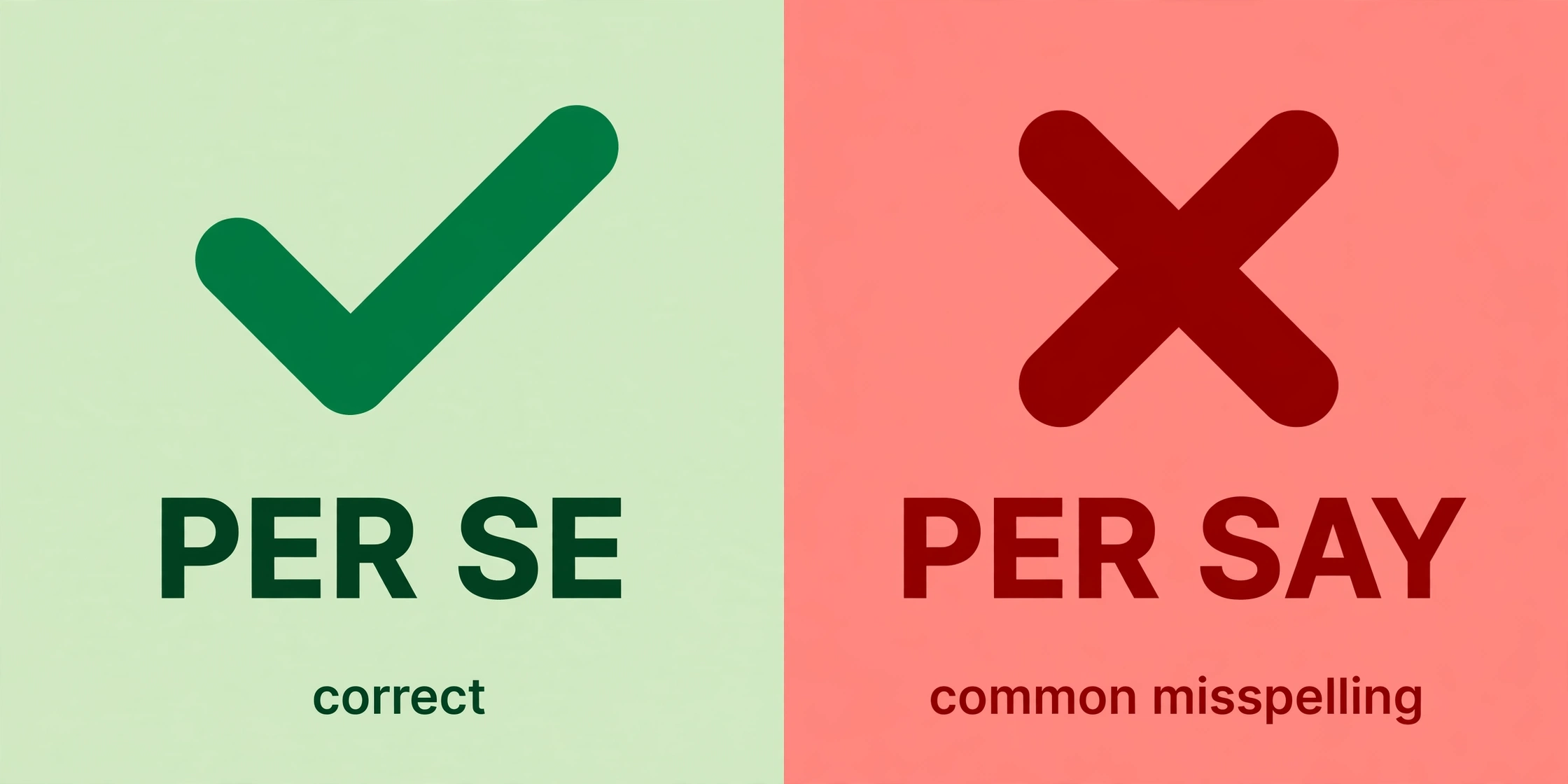
Short answer: it is always “per se”. “Per say” is a misspelling — full stop.
“Per se” comes from Latin and means “by itself” or “intrinsically”. It is pronounced “pur SAY”, and that pronunciation is exactly why so many people spell it “per say”. But spelling it the way it sounds is wrong here.
Real-life examples:
- Restaurant review: “The food was not bad per se — the portions were just too small.”
- Team meeting: “I have nothing against remote work per se; I just miss the office energy.”
- Apology: “I am not upset per se, I am just disappointed we missed the deadline.”
Memory trick: “per se” shares its spelling logic with its Latin roots, not with the English verb “say”. If you hear “pur say” in your head, write “per se” with your hands.
What Is a Predicate Nominative?
A predicate nominative is a noun or pronoun that comes after a linking verb (is, was, are, were, became) and renames or identifies the subject. It is also called a predicate noun.
The formula is simple: Subject + linking verb + [word that renames the subject].
- “My neighbour is a pilot.” (“A pilot” renames “my neighbour”.)
- “The winners were Sara and Tom.”
- “Her childhood dream became reality.”
Try the equals-sign test: replace the linking verb with “=”. “My neighbour = a pilot.” If both sides name the same person or thing, you have found a predicate nominative.
Real-life nuance you should know: “It is I” versus “It is me”. Traditional grammar says a linking verb takes the nominative case, so “It is I” is technically correct — and in a formal presentation or a job interview, it still impresses. In everyday conversation, though, “It is me” is what almost everyone says, and nobody will misunderstand you. Know the rule, then choose your register.
Quick-Reference Table
| Mix-up | Correct choice | Why |
|---|---|---|
| Regardless vs irregardless | Regardless | “Irregardless” is a nonstandard double negative; dictionaries label it nonstandard. |
| Per se vs per say | Per se | A Latin phrase meaning “by itself”; “per say” is a misspelling caused by pronunciation. |
| Predicate nominative | (grammar term, always two words) | A noun after a linking verb that renames the subject, e.g. “She is a teacher.” |
Frequently Asked Questions
Is “irregardless” a real word?
Yes, it is listed in most dictionaries, but it is labelled “nonstandard”. It means the same as “regardless”, and style guides unanimously recommend using “regardless” instead, especially in formal writing.
Can I use “irregardless” in a job application or work email?
You should not. Many hiring managers and professionals consider it an error, and in a competitive application a small mistake like this can quietly count against you. Write “regardless”.
Is it “per se” or “per say”?
It is “per se”, from Latin, meaning “by itself” or “intrinsically”. “Per say” is a common misspelling caused by the pronunciation “pur SAY”.
What does “per se” mean in a sentence?
It means “in itself” or “intrinsically”. For example: “The movie was not boring per se, it was just too long” means the movie itself was fine apart from its length.
What is a predicate nominative example?
In “She is a teacher”, the word “teacher” is the predicate nominative — it follows the linking verb “is” and renames the subject “she”.
What is the difference between a predicate nominative and a predicate adjective?
A predicate nominative renames the subject with a noun (“He is a doctor”), while a predicate adjective describes the subject (“He is tall”). Both follow linking verbs.
The Bottom Line
Three confusions, three clear answers: use “regardless”, write “per se”, and remember that a predicate nominative simply renames the subject after a linking verb. Getting these right will not make you a grammarian overnight, but it will make your writing sharper and your professional communication more credible.
If you love playing with words, you will enjoy our daily Plusword puzzle — and if you want to avoid more traps like these, read our guide to common word mistakes.